
Last updated November 17, 2026
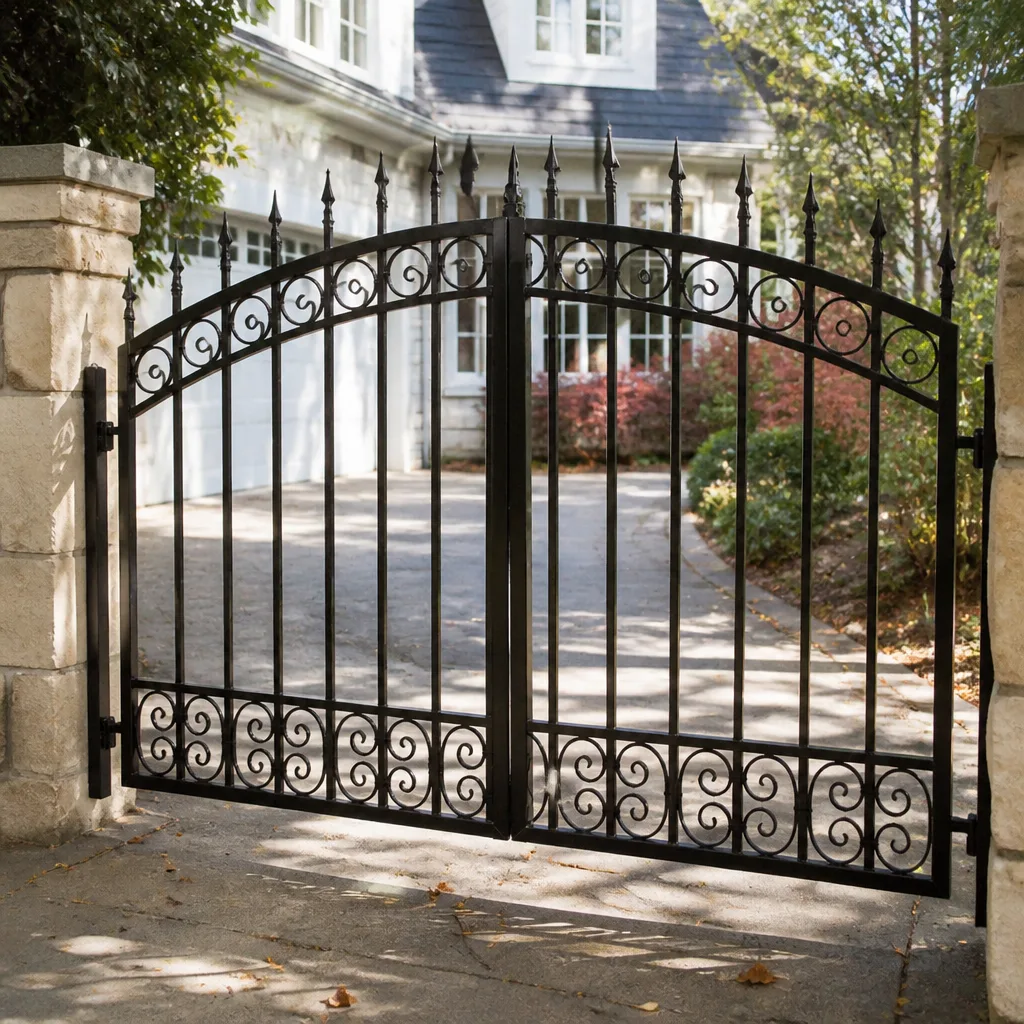 Wrought iron
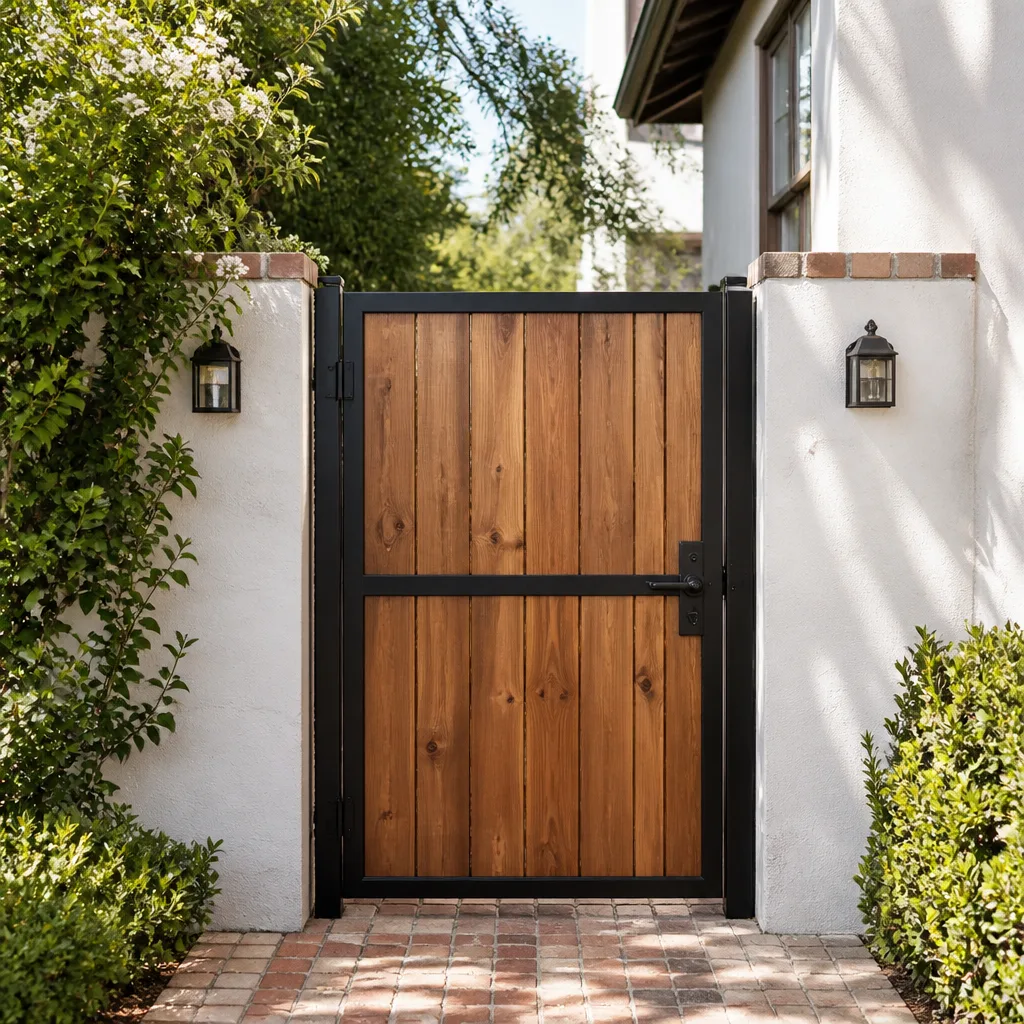 Wood & steel frame
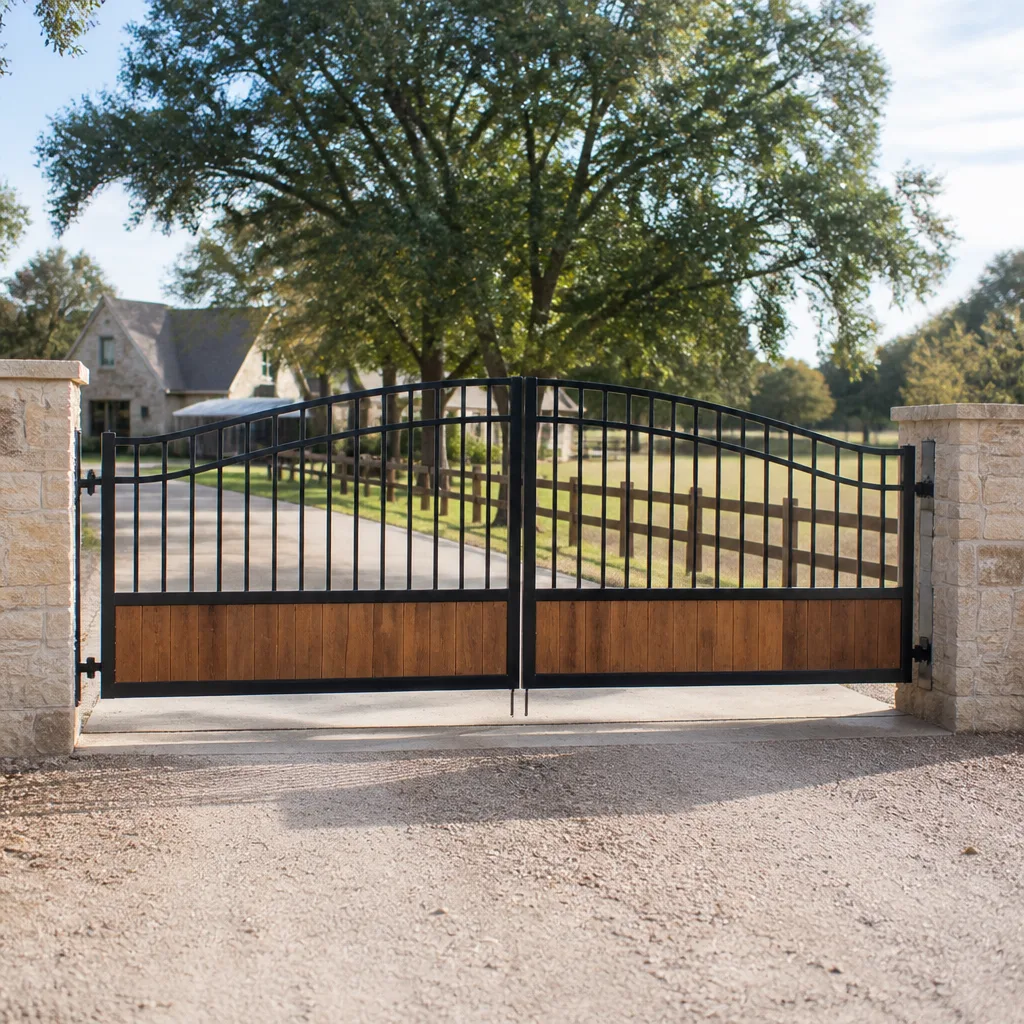 Farm & ranch
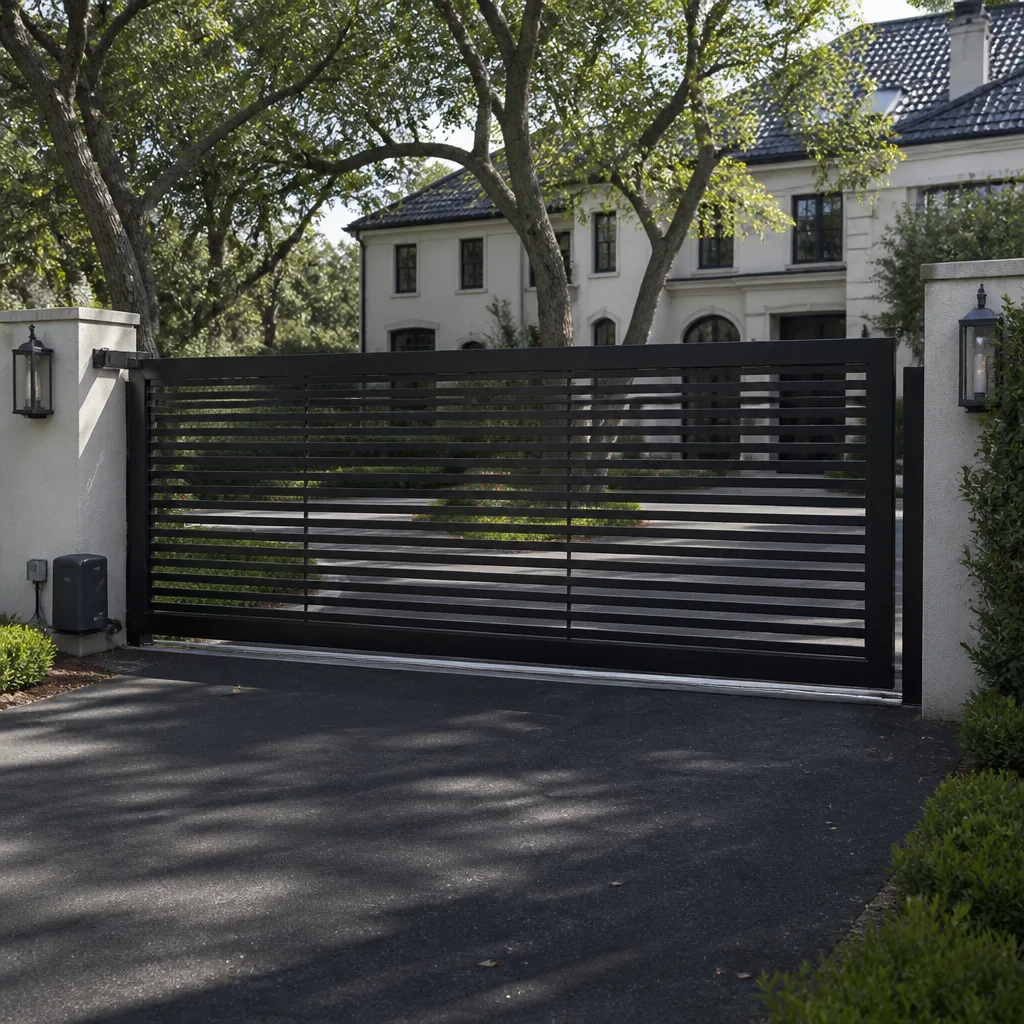 Sliding driveway gates
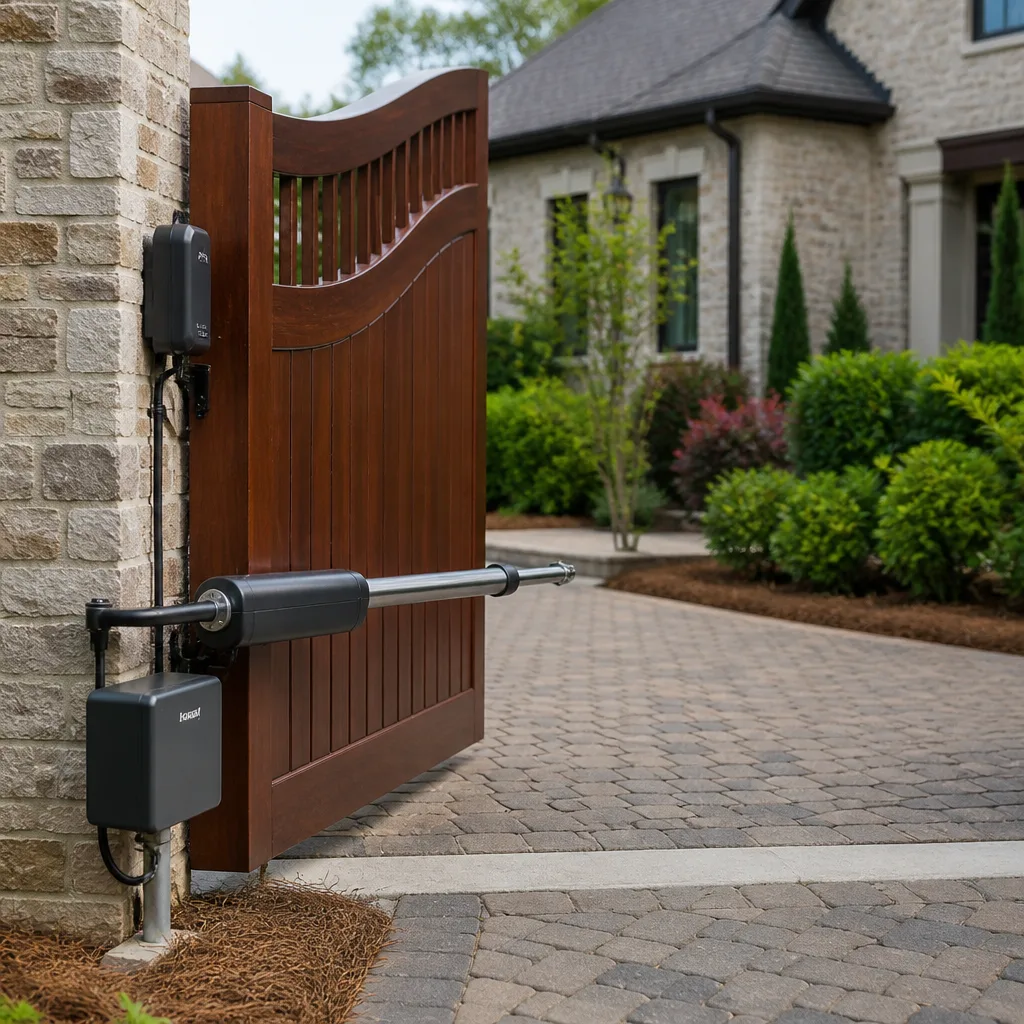 LiftMaster operators
Free on-site gate assessment - hinges, posts, and your LiftMaster or Nice gate operator checked before anything is quoted
The assessment is free and the quote is the invoice.
Get your free estimateHow Long Does Gate Repair Take? Timelines and What to Expect
Most homeowners assume the hard part of a gate repair is the welding. In our experience across Whitney, it’s usually the parts. The single biggest variable that decides whether your gate is working by tonight or next Thursday is whether the failed component is on a shelf in the Las Vegas valley or on a truck from a warehouse three states away. That means the brand and model of your opener matters more than how fast a technician can turn a wrench. This guide breaks the timeline question into its three real parts, shows you how to check your own equipment before you call, and explains what a written guarantee actually changes about the clock.
Quick Answer
Gate repair typically takes one to three hours of actual labor once a technician is on site. The full timeline from your first call to a working gate runs anywhere from same-day to about a week, and the difference is almost always parts availability and scheduling rather than the repair itself. With your opener’s brand and model number in hand when you call, most repairs in Whitney are completed in a single visit.
Styles & brands we work with
- Wrought iron
- Wood & steel frame
- Farm & ranch
- Sliding driveway gates
- LiftMaster operators
Table of Contents
- The Three Questions Behind “How Long Will This Take?”
- Same-Day Versus Scheduled Repair by Failure Type
- Why Identifying Your Opener Brand and Model Saves Days
- Parts Lead Times in the Nevada Market
- Functional Versus Fully Repaired: Which One Do You Have?
- How the 90-Day Done Right Promise Changes the Timeline
- How Whitney Heat and Wind Affect Repair Timelines
- Common Mistakes to Avoid
The Three Questions Behind “How Long Will This Take?”
When a homeowner asks how long a gate repair takes, they’re almost never asking one question. They’re asking three, and each has a different answer. Getting them straight before you dial keeps everyone honest about the schedule.
The first is how long until my gate works again. This is the repair time itself, and it’s short. Most mechanical and electrical fixes on a residential driveway gate take one to three hours once the right parts and the right technician are in the same place.
The second is how long until someone arrives. That’s a scheduling question, and it depends on what failed, what you’ve told us on the phone, and how the day is booked. A gate stuck open across a driveway is handled differently than a sluggish swing that still closes.
The third is how long the fix lasts. A hinge welded back together improperly can fail again in weeks. A motor replaced with the wrong torque rating for your gate’s weight will strain from day one. This is the question most homeowners forget to ask, and it’s the one that separates a repair from a patch.
Keep all three in view. A company that answers only the first question is telling you half of what you need to know. We’ve seen gates in Whitney come back two months after a quick fix because nobody addressed the underlying alignment problem that was wearing out the opener in the first place.
Same-Day Versus Scheduled Repair by Failure Type
Urgency gets all the attention, but failure type is what actually determines whether a repair happens today. Some failures are predictable, common, and stocked. Others need measuring, ordering, or a return visit. Here’s how it breaks down.
Failures typically handled in a single visit
- Roller and hinge wear. The most common gate failure we see. Rollers flatten, hinges loosen, and the gate starts to drag. These are small parts, usually on hand, and the work is straightforward.
- Control board and receiver faults. A gate that won’t respond to the remote but opens fine by hand often has a failed receiver or a control board issue. Replacing these is bench-style work, not fabrication.
- Keypad and access control failures. A keypad that’s stopped reading codes or a loop detector that’s gone blind. Usually a swap-and-reprogram job.
- Safety edge and photo-eye problems. Gates that reverse for no reason are often reading a misaligned or damaged safety device. Adjusting or replacing these is usually quick.
- Weld and structural repairs. Cracked hinge plates, bent frames, sagging cantilevers. Welding on-site with the right equipment, often the same day.
Failures that often need a scheduled return
- Opener motor replacement on an uncommon model. If we don’t have the motor for your specific brand and model, it has to be ordered.
- Battery backup and solar component failures on older systems. These parts vary widely by manufacturer.
- Gates that need a re-hang or major realignment. These are planned jobs, measured and scheduled, not fit into a same-day slot.
Notice what’s not on either list: the urgency of the call. A panicked call about a gate that’s slightly slow is still a single-visit repair. A calm call about a gate with a failed opener on a brand we don’t stock can still take days. Telling us what’s actually broken matters more than telling us how much it matters. For a fuller look at the scope of what we handle, see our Gate Repair in Whitney page.
Why Identifying Your Opener Brand and Model Saves Days
This is the single highest-leverage thing you can do before you call anyone. If you know your opener’s brand and model number, the timeline shrinks. If you don’t, the first visit is partly a scouting trip, and the real repair waits on parts.
Gate openers aren’t interchangeable. A LiftMaster slide operator and a FAAC swing operator share almost no parts, and even within one brand a mid-grade model and a heavy-duty model use different control boards, different receivers, and different motors. A technician who arrives without knowing what you have can diagnose the problem, but can’t always fix it the same day.
How to find your opener’s brand and model in under five minutes
- Locate the operator housing. It’s the metal box near the gate, usually on the hinge side of a swing gate or at the end of the track on a slide gate.
- Look for the manufacturer’s label. Check the underside, the back panel, and the inside of the access door. Most have a data plate with the brand and model number.
- Photograph the label. A clear photo of the data plate is worth more than a description. Send it to whoever you call.
- Check your breaker panel. If the gate has a dedicated circuit, note which one. That saves time on the electrical side.
- Note the gate type. Swing or slide, single or double, and roughly how wide and heavy it is.
With that information, we can tell you before we arrive whether the likely parts are in stock, which shortens the whole process. Our technicians are trained on nine major brands, including Elite and Mighty Mule, so the odds of a first-visit fix go up the moment we know what we’re dealing with. If the problem turns out to be the opener itself rather than the gate, our Gate Motor & Opener in Whitney page covers what replacement involves.
Parts Lead Times in the Nevada Market
Here’s the honest version of parts availability for the brands we service. Nothing here is a promise about your specific model, but it’s the pattern we work with every week in Whitney and the surrounding valley.
- Common consumables: rollers, hinges, safety edges, photo-eyes, remotes, and keypads. Usually stocked locally. Same-day or next-day in most cases.
- Standard control boards and receivers for mainstream brands: LiftMaster and Linear boards are generally available locally or within a day or two. These are the parts that most often let us finish in one visit.
- Mid-tier and specialty boards: FAAC and Elite components vary. Some are in the valley, some ship from regional warehouses in a few days.
- Motors and complete operators: depends entirely on the model. A current-production LiftMaster operator is often available quickly. A discontinued or uncommon Mighty Mule model may need to be ordered, and that can run several days to a week or more.
- Custom fabrication parts: hinge plates, brackets, and gate hardware that have to be welded or machined. Typically a few days from measurement to install.
Two things shift these timelines in your favor. First, calling with your model number in hand so we can check stock before we roll a truck. Second, being realistic about specialty brands. If you’ve got an older Elite operator that’s been reliable for a decade, we’ll do everything we can to source the part, but we’ll tell you honestly if the wait is long enough that a replacement makes more sense. The goal is that you know the schedule before you commit, not after.
There’s a local wrinkle worth mentioning. Summer heat in the Whitney area is hard on control boards, batteries, and receiver components, so demand for these parts spikes from June through September. If you’re calling in the middle of that window about a control board, expect the local supply to be tighter than in February. Calling early in the day and having your model number ready makes a real difference when parts are moving fast.
Functional Versus Fully Repaired: Which One Do You Have?
This distinction deserves its own section because it’s where timelines get fuzzy and homeowners get frustrated. There’s a real difference between a gate that’s working right now and a gate that’s actually repaired, and a good technician will tell you which one you’re getting.
Functional means the gate opens, closes, and does what it’s supposed to, at least for now. It might need follow-up work. A gate that’s functional but not fully repaired often has a temporary adjustment, a stopgap weld, or a part on order.
Fully repaired means the root cause is addressed and there’s no known follow-up needed. The gate is square, the operator is matched to the load, the safety devices are working, and the hardware is sound.
Why does this matter for your timeline? Because a same-day fix is often functional, and a fully repaired job sometimes takes a return visit for a part or a full realignment. When a technician finishes and tells you “this will hold, but the hinge plate should be replaced when the part comes in,” you know exactly where you stand. When they don’t tell you, you assume it’s done, and then you’re surprised three months later.
Ask directly: “Is this functional or fully repaired, and what’s still outstanding?” A straightforward answer is a sign of an honest shop. We’ve seen too many gates in Whitney patched and abandoned because nobody told the homeowner what was still on the list.
How the 90-Day Done Right Promise Changes the Timeline
A written guarantee doesn’t shorten the first repair. What it changes is the clock on everything after it. The 90-Day Done Right Promise is our written commitment: if the work isn’t right, we come back and make it right, no arguing and no paperwork. Here’s what that means for how you think about timelines.
- It covers the workmanship. If a weld fails, a hinge we installed comes loose, or a repair we made doesn’t hold, we return and fix it.
- It covers the follow-up. If we told you a part was on order, the job isn’t finished until it’s installed and working.
- It has a defined window. Ninety days is enough time to catch a repair that was rushed or a part that failed early, and it’s long enough to be meaningful.
What to ask any company before work begins
- “Is the guarantee in writing, and will I have it before work starts?”
- “Does it cover both labor and the follow-up parts?”
- “How long is the window, and from what date does it run?”
- “Will you tell me in writing what’s functional versus fully repaired?”
- “What’s the quoted price, and does it change if the job takes longer than expected?”
Ask those five questions and you’ll learn more about a company than any sales pitch can tell you. The honest answer is the one that includes a written guarantee and a clear statement of what’s outstanding. For customers with a written estimate from another shop, we offer a free second opinion so you can compare before you commit.
How Whitney Heat and Wind Affect Repair Timelines
Gate failures in Whitney don’t happen on a random schedule. They cluster around two things: summer heat and wind. Knowing the patterns helps you anticipate both the repair and the timeline.
Extended heat above 100 degrees is hard on control boards, backup batteries, and the plastic and rubber components inside the operator housing. When a gate starts behaving oddly in July, it’s often an electronics issue rather than a mechanical one, and the part is usually small and quick to replace. Wind is the other factor. Whitney sits where gusts push hard against wide swing gates, and that load transfers into the hinges, the operator arm, and the frame over time. A gate that’s been quietly stressed for a year often fails all at once during a windy stretch.
The practical upshot: if your call comes during a heat wave, don’t be surprised if we ask you to photograph your control board label. And if your gate is dragging or the opener is straining, get it looked at before the next wind event moves it from “functional” to “stuck.” A seasonal tune-up in spring catches these issues before summer or fall pushes them over. For neighborhoods across the Whitney area, a little prevention on hinges and alignment is cheaper than an emergency call in July.
Common Mistakes to Avoid
- Calling without the opener’s brand and model. Without it, the first visit often becomes a scouting trip and the real repair waits on parts. Two minutes at the operator housing saves days.
- Electing the cheapest quote without asking about the guarantee. A lower price with no written coverage is often more expensive within a few months. Ask what happens if the repair fails.
- Forcing a stuck gate open or closed by hand. On an opener-equipped gate, forced movement can damage the operator or strip the drive. Stop and call instead.
- Ignoring a safety edge or photo-eye that’s misbehaving. A gate that reverses for no reason is a safety issue, not a quirk. Don’t wait for it to fail open at the wrong moment.
- Assuming a functioning gate is fully repaired. Ask whether the job is complete or has a follow-up. Confirm it in writing before the technician leaves.
- Waiting until the gate won’t move at all. Small drags and slow reactions are usually cheaper and faster to fix than a full failure. The parts are often the ones that are in stock.
- Using a general handyman for opener electronics. The gate may move again, but the wrong part on the wrong operator strains the whole system. Match the trade to the task.
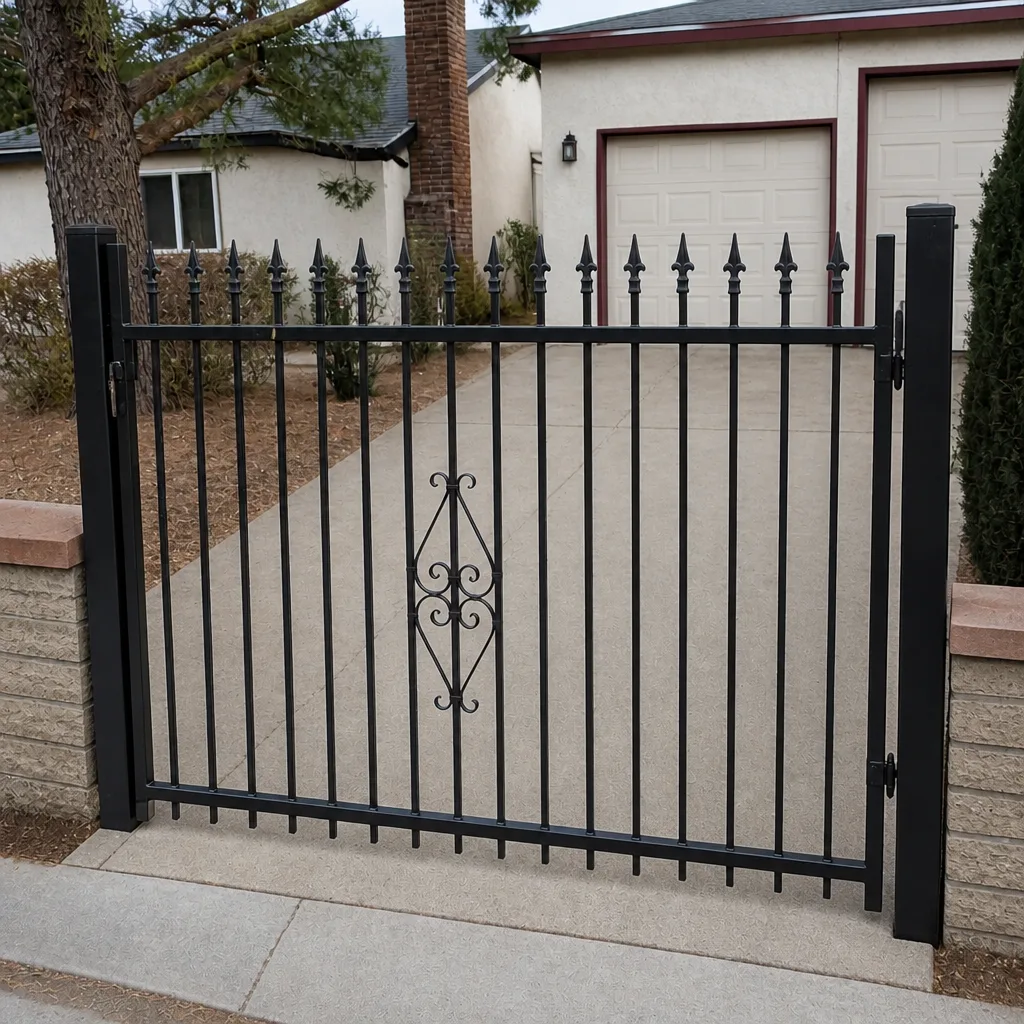
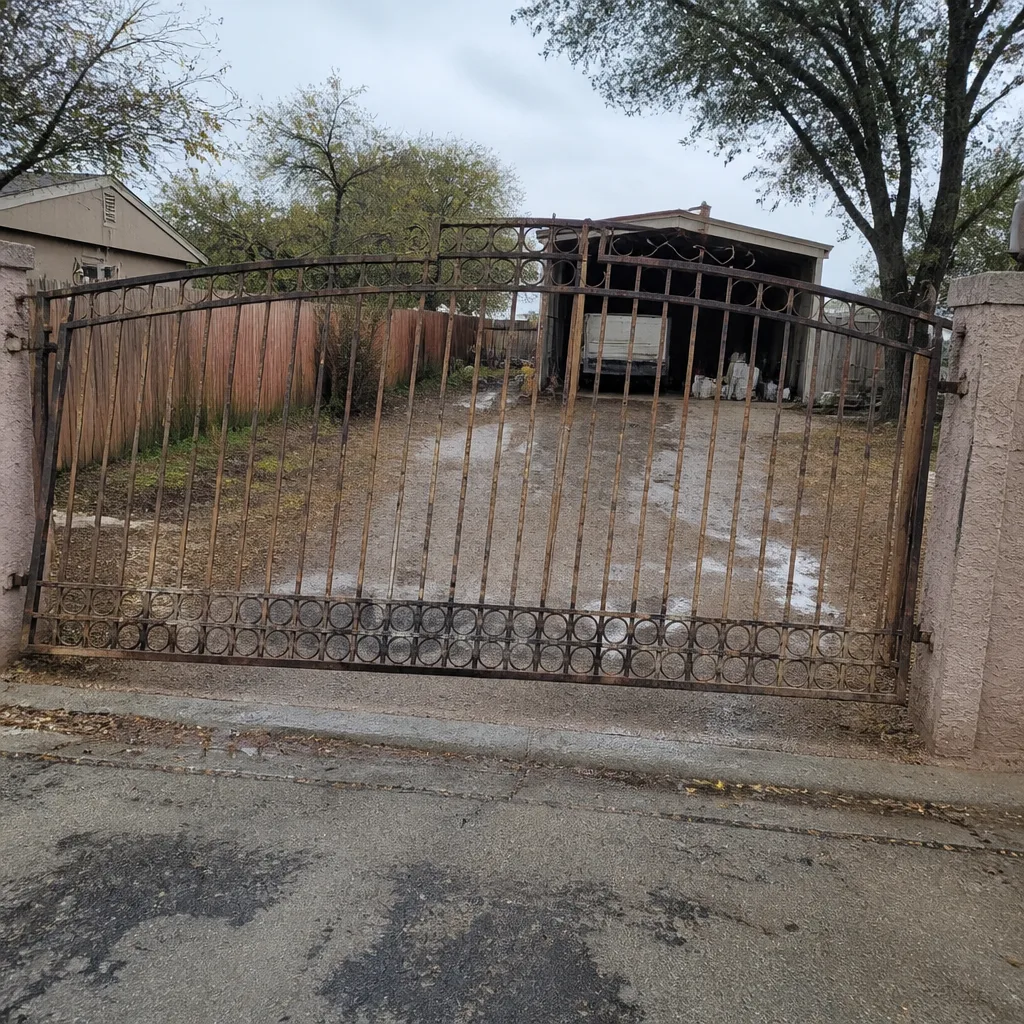
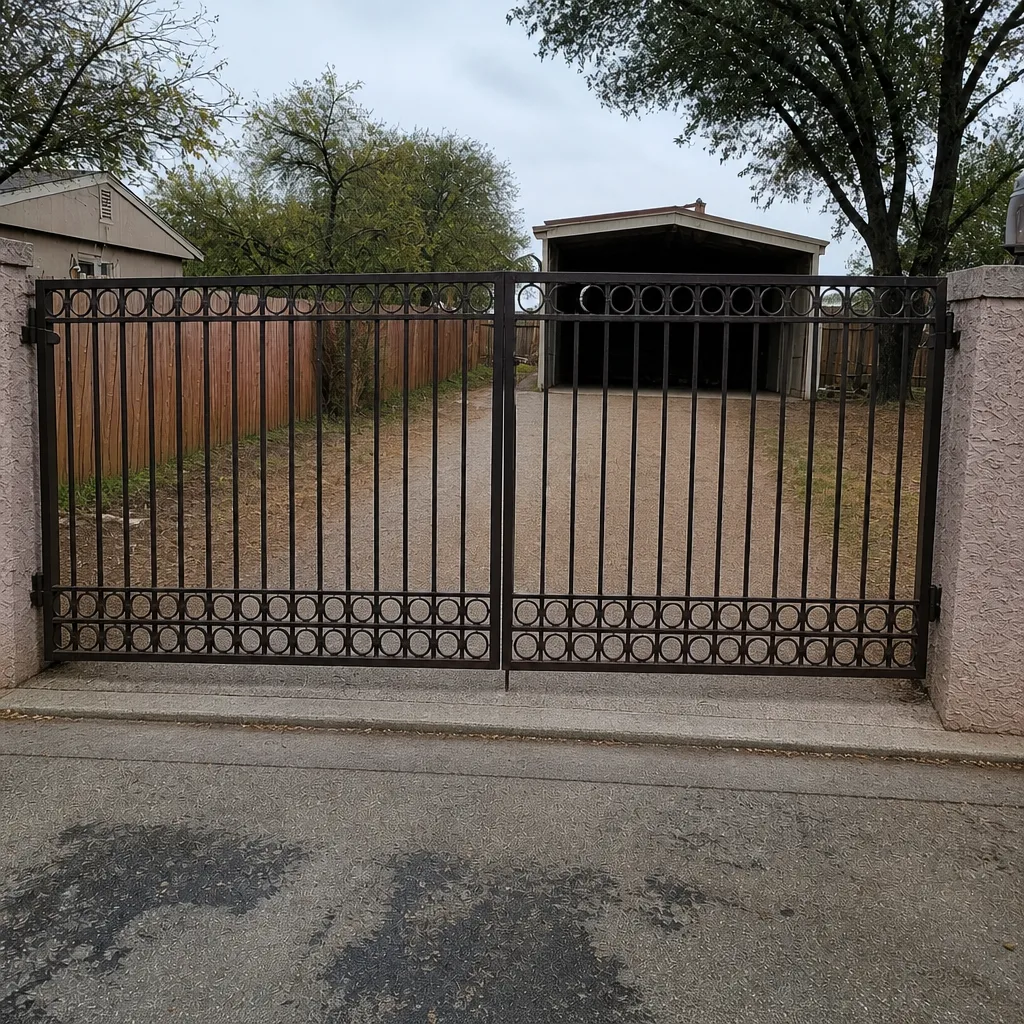
See the difference
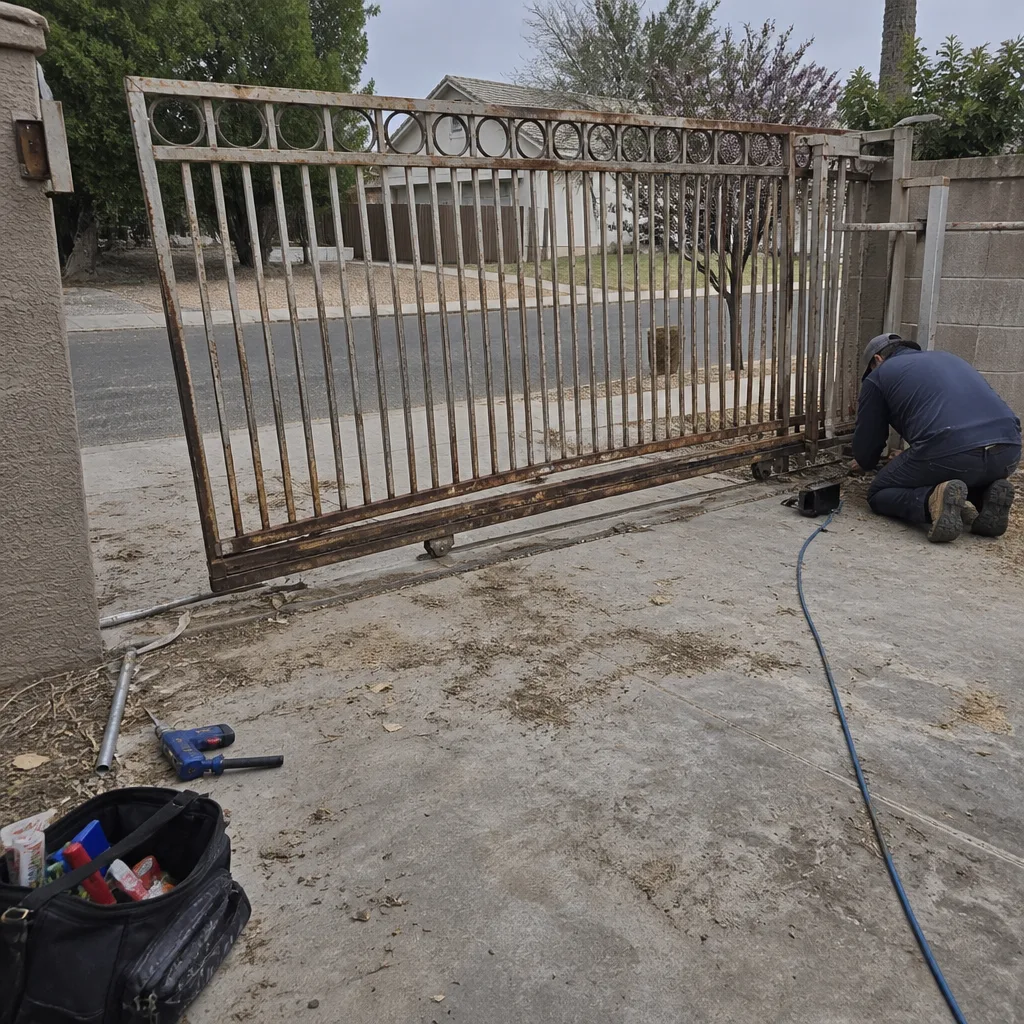 Before
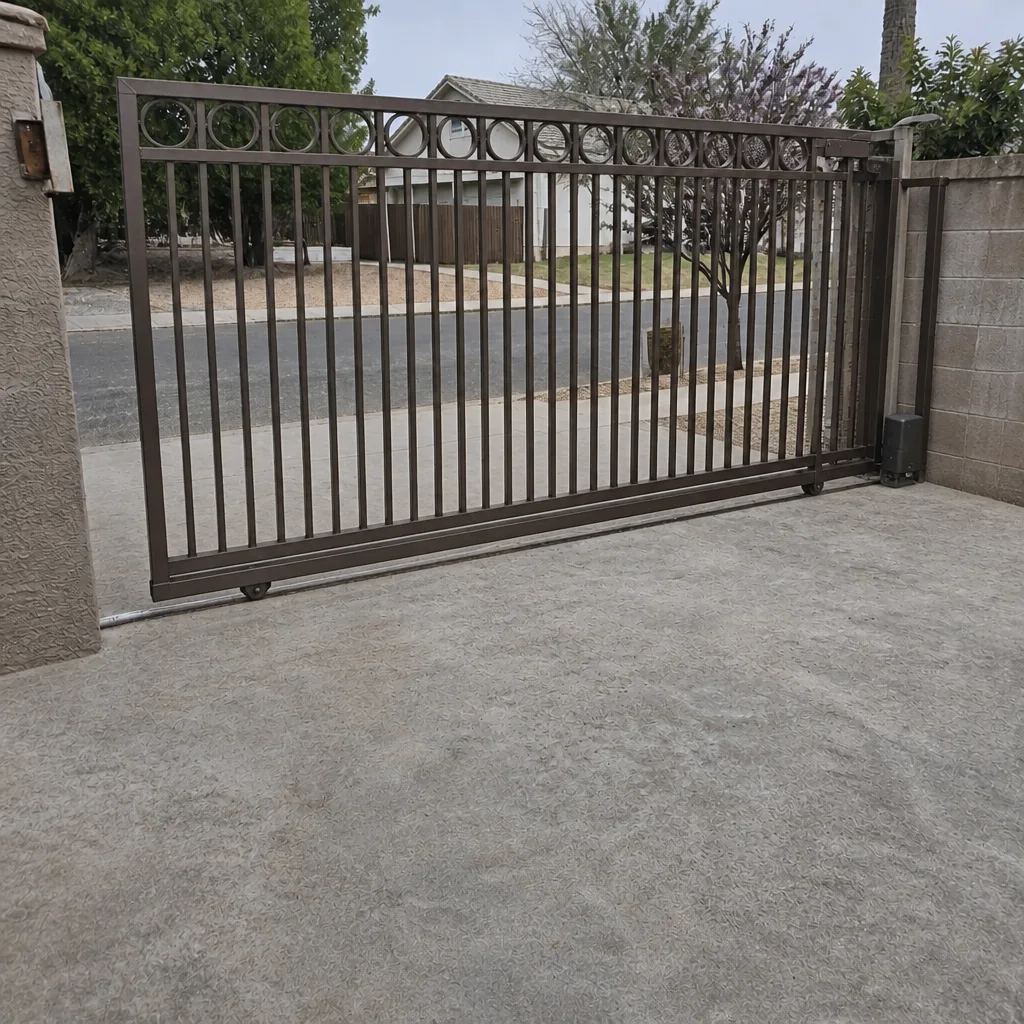 After
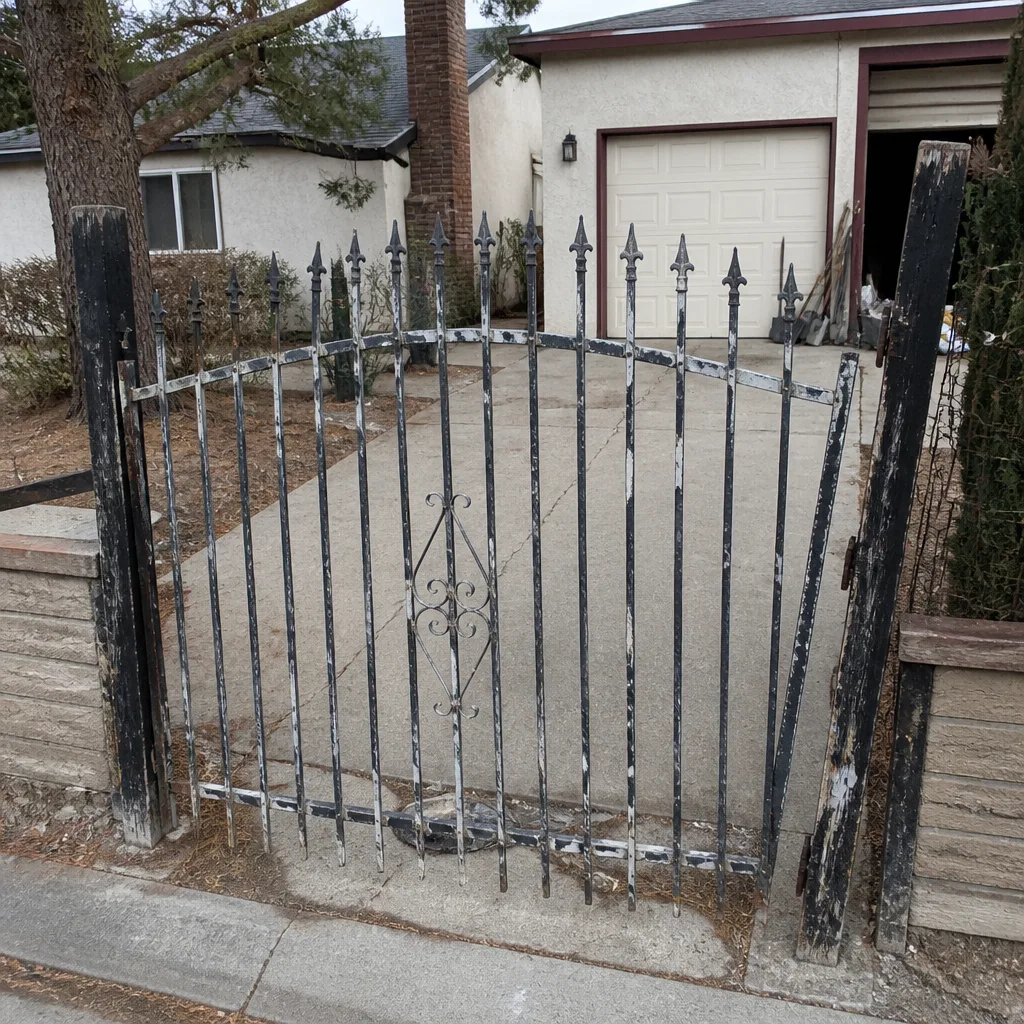 Before
 After
 Before
 After
When to Call a Professional
Call a professional when the gate involves any powered opener, and especially when the failure involves electrical components, the safety devices, or structural welding. Gate operators carry torque and stored mechanical energy. Springs, torsion assemblies, and drive mechanisms can injure someone who’s unfamiliar with how they release and under what load. We don’t recommend opening the operator housing or attempting to release a tensioned drive on your own.
Specific situations that call for a trained technician: a gate that won’t open or close at all; an opener that hums but doesn’t move the gate; a gate that reverses repeatedly; a safety edge that’s damaged or not responding; visible cracks in hinge plates or frame welds; and any gate that drags, sags, or has dropped on one side. Each of these has a specific cause, and the repair is usually faster and safer in trained hands.
Ironworks Gate Co. Whitney offers free estimates in Whitney. Call (855) 928-1304 and a live person will answer, day or night, and help you figure out what you’re dealing with before anyone rolls a truck.
Frequently Asked Questions
Most residential gate repairs take one to three hours of actual labor once the technician is on site and has the right parts. Roller and hinge replacements run on the shorter end; control board swaps and weld repairs on the longer end. The bigger variable is whether the part is on hand when they arrive, which is why the brand and model number matter so much.
Many repairs in Whitney are completed the same day, especially when the needed parts are stocked locally and the failure is mechanical or a common electronics issue. Uncommon models, specialty brands, and major realignments may need a scheduled return for ordering or measurement. Call (855) 928-1304 and we’ll give you an honest answer for your specific gate.
We’re trained and equipped on nine major gate-automation brands, including LiftMaster, FAAC, Elite, and Mighty Mule, and many other models share common components. If your brand isn’t on the list, we’ll tell you honestly whether we can source parts and what the timeline looks like. If we can’t, we’ll say so rather than guessing.
The price is quoted and agreed before any work starts. If the diagnosis turns up something that wasn’t visible on the initial visit, we’ll tell you and get your agreement on the new price before proceeding. No surprises on the bill. Call (855) 928-1304 for a free estimate.
Yes. The 90-Day Done Right Promise is a written guarantee that if the work isn’t right, we return and make it right, with no arguing and no paperwork. It covers the workmanship on the repair. A customer with a written estimate from another shop can also get a free second opinion from us before committing.
Have your opener’s brand and model number photographed, note whether the gate is a swing or slide type, and roughly how wide and heavy it is. Tell us what the gate is doing versus what it should do, and whether the problem came on suddenly or slowly. That information lets us check parts stock before we schedule, which usually shortens the whole timeline.
The Bottom Line
The timeline for a gate repair breaks into three parts: how long until it works, how long until someone arrives, and how long the fix lasts. The first is usually a few hours of labor; the second depends on parts and scheduling; the third depends on whether the job was done right and backed in writing. The single highest-leverage step you can take is to photograph your opener’s brand and model before you call. It shortens the wait, and it’s the difference between a same-day fix and a return visit. A written guarantee, confirmed in writing before work begins, is what protects the third answer. Read our guide to Gate Installation in Whitney if you’re weighing a full replacement instead, and our Ironworks Gate Co. Whitney home page for the full scope of what we do. When you’re ready, call (855) 928-1304 for a free estimate. A live person will answer, day or night.
Written by the team at Ironworks Gate Co. Whitney.